Determination of Soil and Groundwater Contamination
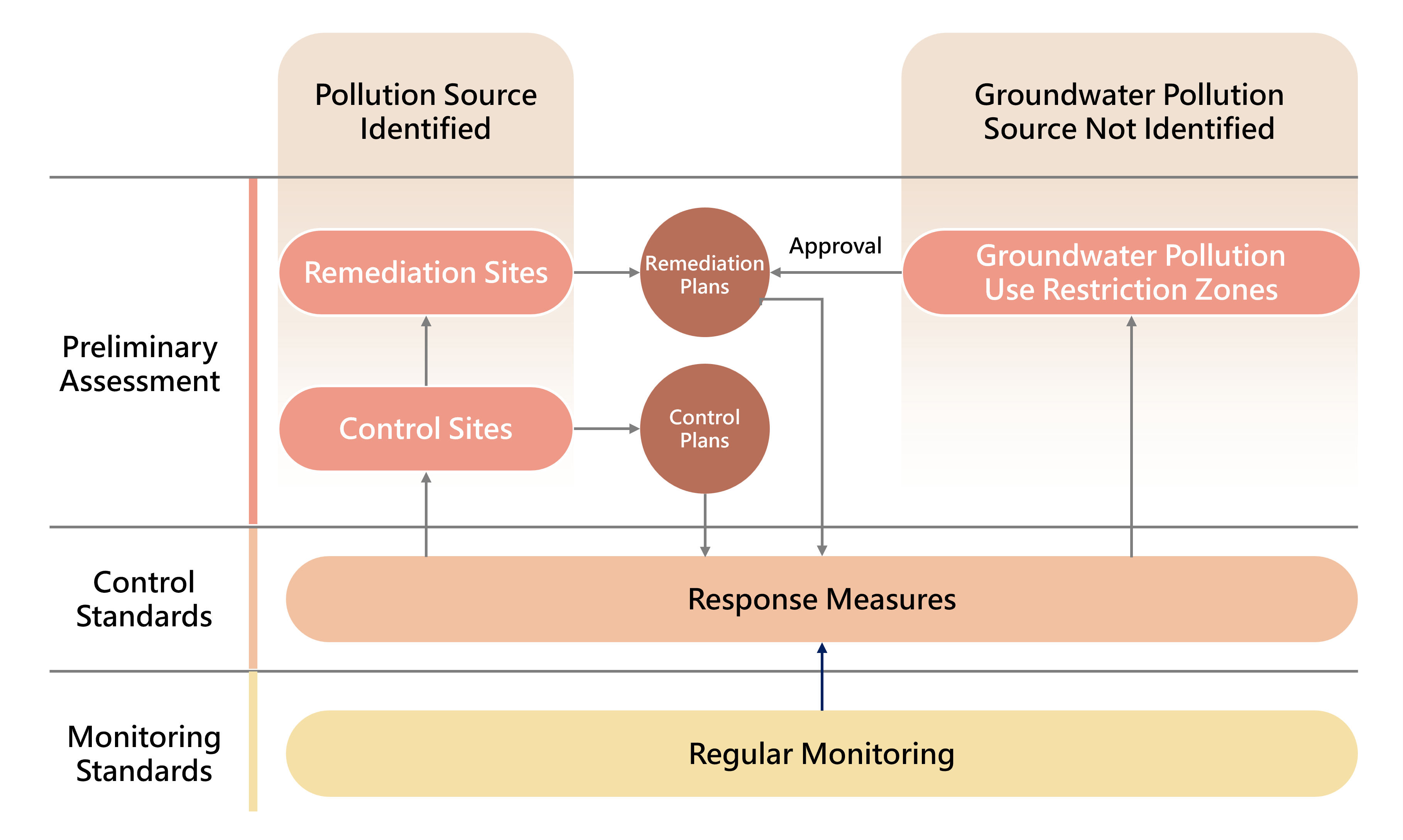 Figure 1. Site improvement procedures
Site Discovery and Verification
Competent authorities at all levels shall verify sites suspected of soil or groundwater pollution. If pollutants have been improperly discharged, leaked, injected, or disposed of, authorities shall first control the pollution sources under relevant environmental laws and investigate the extent of contamination.
Control Sites
For sites where the source of soil or groundwater pollution is clear and pollutant concentrations meet soil or groundwater control standards, the competent authority shall designate the site as a soil and groundwater pollution control site.
Control Plan
For control sites not yet designated as remediation sites, the competent authority may require the polluter to submit a pollution control plan, which shall be implemented upon approval. After implementing the plan, if pollutant concentrations fall below the control standards, an application may be submitted to lift the control designation, which shall be publicly announced upon approval.
Preliminary Assessment
If, after preliminary assessment, a control site meets any of the following conditions, the municipal or county (city) competent authority shall submit the case to the central competent authority for review and designate it as a remediation site:
- 1. The Total Potential Impact Score (TOL) reaches 1,200 points or more.
- 2. Other significant pollution situations as designated by the central competent authority.
Typically, preliminary assessments of newly announced control sites should be completed and submitted to the central authority within 45 days.
Health Risk Assessment
For control sites where pollutants cannot be remediated below the control standards due to geological conditions, pollutant characteristics, or remediation technology limitations, the central competent authority may approve remediation targets based on environmental and health risk assessment results. Once targets are achieved, risk management and control plans must be implemented to lift the remediation site designation, with ongoing monitoring and control of the site.
Remediation Sites
If a control site poses potential risks to public health or the living environment after preliminary assessment, the municipal or county (city) competent authority shall submit it to the central competent authority for review and designate it as a soil and groundwater pollution remediation site. Within seven days of the central authority's announcement, the site shall be registered and made available for public viewing at relevant local offices.
Remediation Plan
The polluter of a remediation site shall develop a soil and groundwater remediation plan based on investigation and assessment results under Article 12. The competent authority reviews and approves the plan for implementation. Approved plans are submitted to the central competent authority for record and summary publication.
Groundwater Pollution Use-Restricted Areas
If, during verification under Article 12, groundwater pollutant concentrations reach control standards but the source is unclear, the competent authority shall announce groundwater use-restricted areas and implement necessary emergency measures in accordance with Article 15.
Necessary Emergency Measures
To mitigate pollution hazards or prevent further spread, competent authorities shall implement necessary measures according to the actual conditions of control or remediation sites, including:
- 1. Order the polluter to cease activities, suspend operations, or partially/fully halt work.
- 2. Investigating groundwater pollution under the Water Pollution Control Act and tracing polluter responsibility; notifying residents to stop using polluted water sources and restricting groundwater well use if necessary.
- 3. Providing alternative drinking water or coordinating with water supply authorities.
- 4. Posting warning signs or erecting fences.
- 5. Notifying agricultural and health authorities to test affected or potentially affected agricultural and fishery products; controlling or destroying contaminated products if necessary and providing appropriate compensation; restricting cultivation of specific crops if needed.
- 6. Evacuating residents or restricting personnel activity.
- 7. Removing or cleaning pollutants.
- 8. Implementing other necessary emergency measures.
Delisting of Sites
After implementing soil or groundwater control or remediation plans and completing remediation, the responsible party shall submit a completion report to the local or central competent authority for approval. Upon approval, the authority shall:
- 1. Announce the removal of control or remediation designation and revoke public viewing.
- 2. Announce the lifting or revision of soil or groundwater pollution control area designations.
- 3. Instruct the land registration authority to cancel any prohibitions on land transactions.